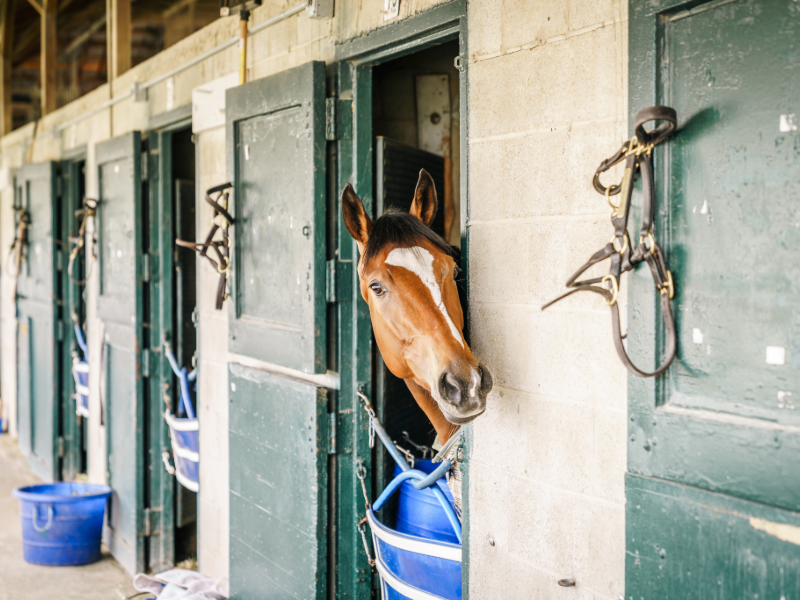
It usually starts with a phone call. A horse two barns down at the track has spiked a fever, or a trainer mentions that strangles has turned up at a nearby show facility. Suddenly the wash rack, the water buckets, and the trailer everyone’s been hauling in are suspects in a potential disease outbreak.
Disinfection is one of the few biosecurity tools handlers and stable managers can control, but only if the right product is chosen and used correctly. A disinfectant that sits unused in a barn aisle, or one that’s applied incorrectly, doesn’t protect anyone.
Here’s the key questions to ask when selecting the best disinfectant for your situation.
What’s In the Disinfectant?
Every disinfectant works because of its active ingredient — the compound that kills the pathogens. Most conventional options rely on synthetic quaternary ammonium compounds (aka “quats”), chlorine bleach, or accelerated hydrogen peroxide. These are effective, but many require precautionary handling: gloves, eye protection, ventilation, and careful storage away from feed and tack. Bleach in particular breaks down quickly once diluted and can corrode metal surfaces over time.
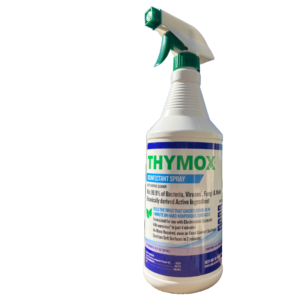
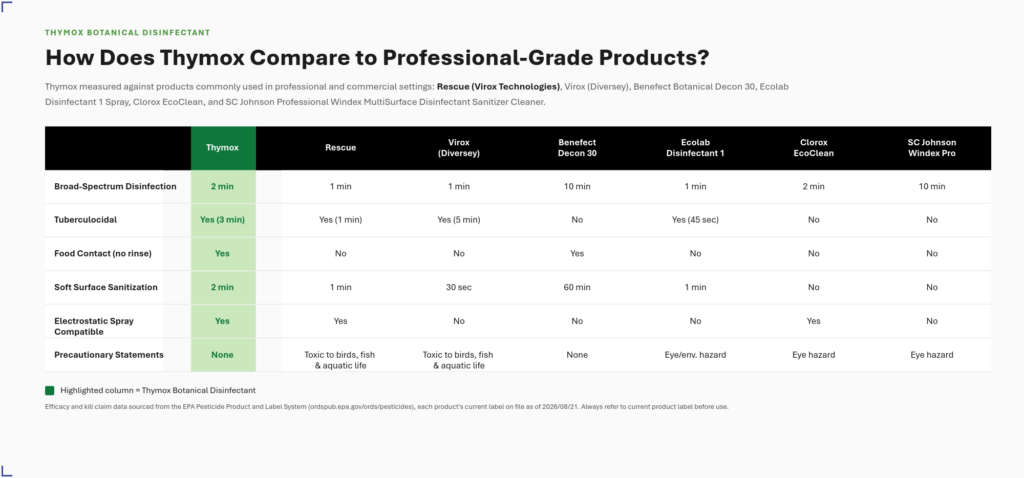
Plant-based active ingredients — “botanical” — are a newer alternative. Thymox Botanical Disinfectant Spray, for example, uses thymol, derived from the herb thyme, as its active ingredient. It carries no precautionary warnings and leaves no harsh chemical residue behind. This kind of formulation matters most in barns, where feed buckets, stall surfaces, and equipment all get handled directly by horses and people alike.
What Does it Kill?
Not all disinfectants are effective against the same pathogens, and label claims vary widely. When comparing products, look for an Environmental Registration Agency registration number and check what organisms are specifically listed on the label. A disinfectant registered for use against non-enveloped viruses, for instance, is generally a stronger option, because those are harder to kill than enveloped viruses.
Thymox is EPA-registered to kill 99.9% of disease-causing viruses and bacteria, including EHV-1, strangles, equine influenza, and mold and fungus, making it relevant to most of the pathogens barns actually worry about.(Its EPA label also names norovirus specifically, tested using feline calicivirus as the required surrogate organism. That’s a meaningful detail because norovirus is a non-enveloped virus, a class that tends to be harder to kill than the enveloped viruses most disinfectant labels list. A product effective there is generally effective against a broader range of pathogens overall.)
How Fast Does it Work?
Contact time, how long a surface needs to stay visibly wet, matters as much as what’s in the bottle. A product that requires 10 minutes of wet contact is rarely used correctly in practice, because surfaces dry out or get touched before the disinfectant has finished working.
Shorter contact times mean a treatment is more likely to be effective on a busy barn schedule. Thymox is rated for broad-spectrum disinfection in two minutes or less across most pathogens.
How Safe Is It?
Safety data is worth checking directly rather than assuming from a product’s marketing. The EPA rates disinfectants by toxicity category, and products in the lowest-risk category typically require no special protective equipment.
Thymox falls into that safest-use category and carries “no rinse required” food-contact approval, meaning a surface can be disinfected without worrying about chemical residue contaminating what touches it next. (Thymox and most surface disinfectants like it are formulated for inanimate surfaces such as buckets, stalls, and equipment, not for wound care.)
How is it the Disinfectant Applied?
Exact application steps, how much product to use, how long a surface needs to stay wet, and the approved method of application, are always spelled out on the product’s EPA-approved label. Following those instructions precisely is what makes a disinfectant perform the way it’s rated to. Skipping or shortening a step is one of the more common reasons a disinfectant fails to work as expected.
The application method also matters more in a barn than almost anywhere else, because the same disinfectant might need to cover a single water bucket or an entire wash rack. Many disinfectants also aren’t compatible with electrostatic sprayers, which limits options for facilities trying to cover large areas efficiently. Thymox is EPA-registered for use with electrostatic sprayers. It comes in sizes ranging from a 250-gallon tote for large facilities and veterinary hospitals to 32-oz spray bottles for everyday use and travel.
Does it Do More than Disinfect?
A disinfectant that also functions as a cleaner and degreaser cuts down on the number of products needed at the barn. Thymox works as a cleaner, degreaser, and sanitizer in addition to a disinfectant, with a lemongrass scent that tends to be well-tolerated by people (and disliked by flies). It’s rated safe for water and feed buckets, leather, equipment, stall walls and guards, flooring, and feed room counters – even kitchen counters.
Biosecurity Best Practices
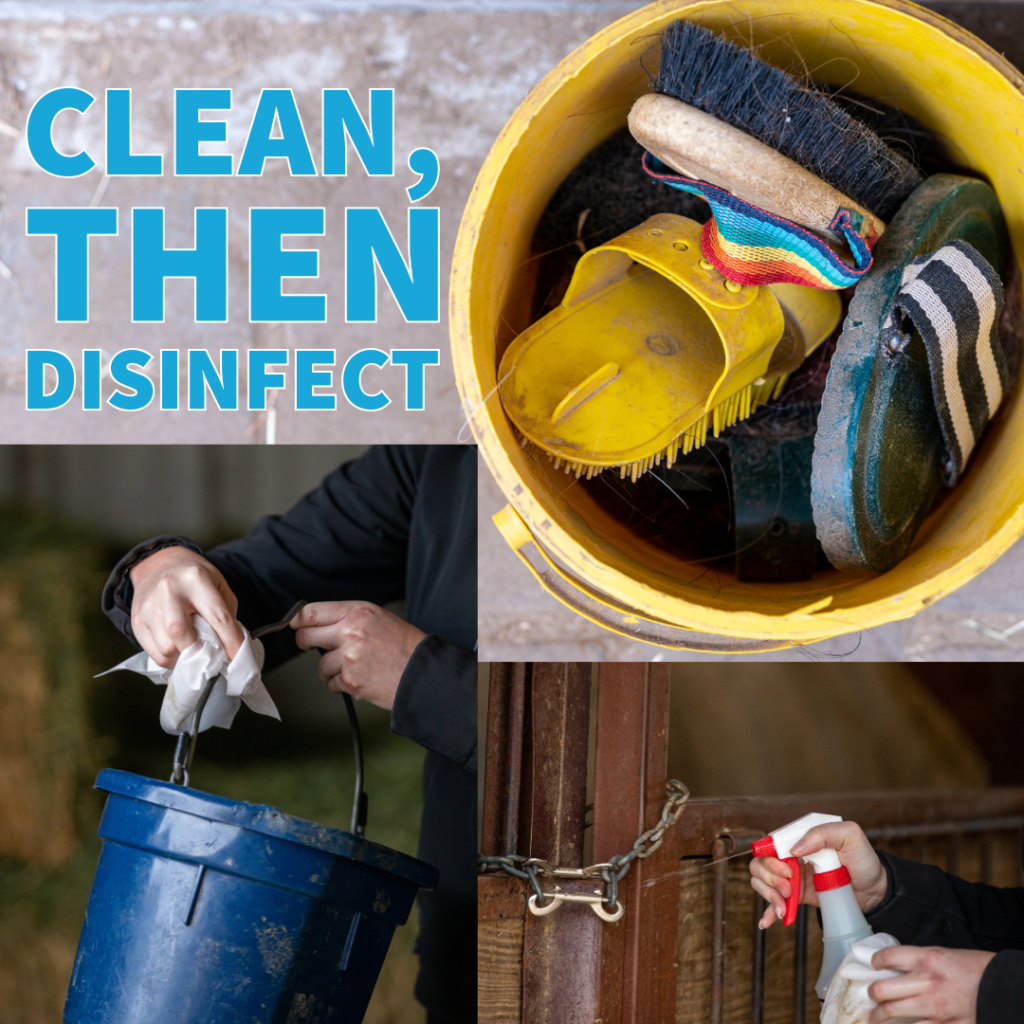
Beyond product selection, a few habits make any disinfectant more effective. All surfaces should be cleaned before they’re disinfected. Organic material like dirt, manure, or hay residue can shield pathogens from a disinfectant’s active ingredient, no matter how strong it is. Keep dedicated equipment (buckets, brushes, wheelbarrows) for any horse in quarantine and consider doing the same for all horses on the property.
Above all, disinfecting should be part of everyday routines. As with all aspects of animal health, disease prevention beats treatment every time.
Choosing a disinfectant is ultimately about matching the product to how a barn actually operates day to day. An effective product that never gets used because it’s inconvenient or intimidating to handle is useless. That’s the real case for something like Thymox – it’s strong enough for the pathogens that matter, but simple enough to become part of the daily routine.